

The 10 Most Instagrammable Spots in Ushuaia (and How Not to Freeze to Death Trying)
Ushuaia is, without exaggeration, one of the most photogenic cities on the planet. The Beagle Channel, snow-covered mountains, lighthouses lost in the southern sea, penguins staring at the camera as if they have no idea what’s going on… every corner of the End of the World is a postcard waiting to be captured. The problem is that many travelers arrive without knowing exactly where to go, when to go, or how to avoid ending up with frozen fingers before they can even press the shutter.
That’s what this guide is for. The 10 most Instagrammable spots in Ushuaia, with everything you need to know to take the photo that will put you on the map (and survive the attempt).
1. Les Éclaireurs Lighthouse — The photo everyone is looking for at the End of the World
If there’s one image that defines Ushuaia, it’s this one. The Les Éclaireurs Lighthouse —whose name in French means “the illuminators”— has been guiding sailors since 1920. It’s an 11-meter-high brick structure, 3 meters in diameter, dressed in red and white stripes that stand out against a brownish-gray rocky landscape.
This is the place everyone imagines before traveling to Ushuaia, and one you can see up close from a catamaran. The captain gets close enough for you to fully appreciate it and capture that must-have photo with the lighthouse in the background: the photo that represents your time in Ushuaia, the one travelers from all over the world seek as proof they reached the End of the World.
Landing on the island is not allowed, as it is not open to the public. However, from the boat you can observe local wildlife: cormorants and sea lions visit daily and rest on the surrounding rocks.
Fun fact: many people call it “The Lighthouse at the End of the World,” but that name actually belongs to the San Juan de Salvamento lighthouse, located on Isla de los Estados and made famous by Jules Verne’s novel.
📸 How to get there: Only by boat from Ushuaia’s Tourist Pier (Av. Prefectura Naval). The classic navigation lasts about 3 hours and also visits Sea Lion Island and Bird Island. Book in advance, especially in high season.
🧥 Anti-freeze tip: Bring a waterproof jacket, hat, and gloves even if the day looks clear. The wind on the water is much stronger than on land, and the cold cuts through. The catamaran has a heated indoor area where you can warm up between shots.
2. Ushuaia Sign — Big letters in the heart of it all
The most modern sign in Ushuaia, located at the intersection of Pasarela Luis Pedro Fique and Avenida Jorge Garramuño, has become one of the most visited spots by tourists, turning into an urban symbol of the city. It’s the classic large-letter sign with the city’s name, perfect for that “I made it” photo.
You’ll find it along the waterfront, just meters from the tourist pier where Beagle Channel tours depart. Free access, open all day, just steps from downtown. One of the easiest photos to get in Ushuaia—and still one of the most sought after.
📸 Best time: Early morning or during the “golden hour” at sunset, when the channel’s light creates a spectacular background.
🧥 Anti-freeze tip: It’s completely exposed on the waterfront. The channel wind can surprise you. A good hat and scarf will do the trick. The photo is worth 30 seconds of cold.
3. “Southernmost City in the World” Sign — A title no one disputes
Ushuaia proudly holds the title of the southernmost city in the world—and makes sure everyone knows it. This iconic sign on the waterfront—near the catamaran boarding area—is another must-have photo for any traveler reaching the End of the World.
This artistic piece was created by Elsa Zaparat and is part of the city’s photographic circuit. It is also located along the waterfront, like the large-letter sign, just 900 meters away. You can read more about the history of the sign in El Diario del Fin del Mundo.
📸 Photo tip: Combine this photo with the large-letter sign and the view of the Beagle Channel in a single walk along the waterfront. They’re all in a row.
🧥 Anti-freeze tip: Free access all day. Being right on the channel, the wind can be brutal. Always dress warm. Always.
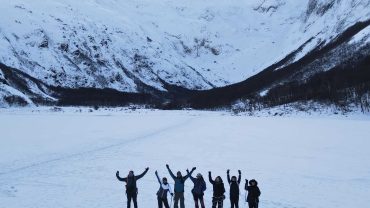
4. Making a Snow Angel — Ushuaia’s most fun photo
5. End of Route 3 Sign — The end of America
This is one of the photos with the most emotional significance of all. What’s amazing about the End of Route 3 sign is that it doesn’t just mark the end of Argentina’s National Route 3, but also the end of the Pan-American Highway that connects Fairbanks, Alaska, with Tierra del Fuego National Park. Every visitor wants this photo, which symbolizes the beginning or the end of a journey across the Americas.
Every year, travelers from all over the world make a huge effort to reach the sign located in Lapataia Bay, inside the National Park. You’ll see people arriving on foot, by bicycle, motorcycle, motorhome, or even in vintage or classic cars after traveling thousands of kilometers across the American continent.
To reach the end, you must enter Tierra del Fuego National Park, west of the city, and drive to Lapataia Bay. It is here that a wooden sign with yellow letters tells travelers that the road has ended—right there, between the Andes and the sea.
📸 How to get there: Accessible by car, taxi, private transfer, or through excursions to the National Park. Many tours include this stop. The park has an entrance fee.
🧥 Anti-freeze tip: Lapataia Bay is in the heart of Patagonian wilderness. The wind can be intense even in summer. Dress in layers, bring waterproof clothing, and wear proper footwear. The reward is huge.
6. Ushuaia’s Sky — Sunsets, dramatic clouds, and southern stars
7. Martillo Island Penguin Colony — The cutest locals
Few photos get more “aww” than a penguin looking straight into the camera in its formal suit. In Ushuaia, that’s possible. About 90 kilometers from the city lies Martillo Island, the only penguin colony in Tierra del Fuego. Between October and April, you can spot two species that come here for their breeding season: the Magellanic penguin and, in smaller numbers, the Gentoo penguin.
From November to March is the peak of reproductive activity. During this time, penguins build their nests with stones and small branches, mate, and lay eggs. Occasionally, King penguins can also be seen. The navigation to Martillo Island also includes Les Éclaireurs Lighthouse, Sea Lion Island, and Bird Island, making it one of the most complete and unmissable excursions.
Walking tours on Martillo Island have very limited availability—some allow only 40 people per departure—and sell out quickly. The most prepared travelers secure their spots 5 to 6 months in advance.
📸 How to get there: Boat navigation from Ushuaia’s Tourist Pier. Approximate duration: 5 hours. Advance booking is mandatory during high season.
🧥 Anti-freeze tip: Bring waterproof warm clothing, comfortable shoes, a hat, gloves, and sunscreen. Yes, sunscreen—the Patagonian sun is strong, especially in summer, and reflects off the water and snow.
8. Panoramic view from the Aeroclub or Pasarela Pedro Fique — The full picture
For a panoramic photo that shows Ushuaia as a whole, the Aeroclub area and the Luis Pedro Fique walkway are the perfect spots. From this ارتفاع, you get a sweeping view of the city, including Cerro Martial, Mount Susana, the bay where boat tours depart, the peninsula where the airport is located, the Beagle Channel, and even the Chilean coast.
To get there, you can walk or drive to the aeroclub at the end of Luis Pedro Fique Street. Just a few steps before reaching the aeroclub, there are signs indicating how to access the panoramic viewpoint.
📸 Photo tip: Use a wide-angle lens to capture the full panorama—the channel, the islands, the mountains, and the city in a single shot.
🧥 Anti-freeze tip: It’s an open and windy area. Stick to the basics: jacket, hat, and scarf. Totally worth it.
9. Cerro Martial — Ushuaia from above
10. Skiing at Cerro Castor — The most epic winter photo
Cerro Castor is a ski resort located on the southern slope of Mount Krund, 26 km from the city of Ushuaia. The typical season runs from June to October and, due to its geographical location, it is the longest among Argentina’s main ski resorts.
With 600 skiable hectares, the resort offers more than 30 slopes for all levels, off-piste areas, one snowpark, and 12 lifts. Official website: Ski at Cerro Castor
Beyond the sport itself, Cerro Castor is a top-tier photographic setting: skiers descending slopes lined with snow-covered lenga forests, the city of Ushuaia visible in the distance, and that endless Patagonian sky.
Cerro Castor maintains average temperatures between -5 and 5 degrees, ensuring perfect snow quality. It features a children’s snow park, daycare for babies, ski and snowboard school, several restaurants and cafés, and equipment rental services.
The classic shot: mid-descent, with the landscape in the background and powder snow spraying. Or from the chairlift, with the entire Tierra Mayor Valley spread out below.
📸 How to get there: 26 km from downtown Ushuaia via Route 3. Accessible by organized shuttle services or private vehicle. Book your ski pass in advance during the winter holiday season.
🧥 Anti-freeze tip: Here, the cold is part of the plan. A warm, waterproof ski jacket and pants are essential. Also bring snow boots, goggles, a hat, and gloves to protect against both the cold and the sun. Full equipment rental is available both at the resort and in shops in downtown Ushuaia.
General Tips to Avoid Freezing (seriously)
Ushuaia is incredibly photogenic, but the Patagonian weather does not forgive improvisation. These basic rules apply to almost all the spots on this list:
- Layering rule: Never rely on a single thick garment. Always wear multiple thin layers that you can add or remove depending on the situation. First layer: thermal. Second layer: mid-layer (fleece or wool). Third layer: waterproof and windproof outer shell.
- Always wear a hat, gloves, and scarf: Even in summer. With wind, the wind chill can drop several degrees below zero when the sun is hidden.
- Waterproof footwear: Regular sneakers in Ushuaia are a guaranteed way to end up cold and wet within the first 10 minutes.
- The weather changes in minutes: Sun, rain, snow, and fog can all happen on the same day. Always bring rain gear, even if the sky looks clear.
- Phone battery: Cold temperatures drain batteries much faster. Charge your phone before heading out and carry a power bank in an inner pocket (closer to your body, where it stays warmer).
- Sunscreen is a must: In summer and in snowy areas, the Patagonian sun reflects intensely. Getting sunburned in Ushuaia is easier than it seems.
Want to Combine Photos with Experiences? We Have the Perfect Tour
If you want to capture the best spots in the city without wasting time organizing transportation, our City & Wine Tour combines 3 Instagrammable stops in downtown Ushuaia with a completely different experience: a wine tasting that lets you discover the flavors of Patagonia with the End of the World landscape as your backdrop.
Ideal for those who want to take home the classic photos of the city while also enjoying a unique gastronomic experience. A tour that blends the visual, the cultural, and the sensory in a single outing.
📩 Contact us to reserve your spot on the City & Wine Tour — availability is limited.
Comment (0)