

The wind erased nothing. Every story remained etched into the stones.
Imagine this: the year is 1911. A ship slowly leaves the port of Buenos Aires, heading south—far south, beyond the edge of where the map still seems to make sense. On board, bound by steel shackles that allow no more than six inches of movement, travel men who have lost their names. They are now nothing more than numbers.
Their destination is the Ushuaia Prison, the Prison at the End of the World. A place deliberately built at the edge of the planet so that no one could escape—not only because of its walls, nearly half a meter thick, but because of something far more formidable: the Beagle Channel, the Antarctic winds, and the certainty that there was nowhere to run.
Today, that very same building is one of the most visited museums in Argentine Patagonia. Yet within its icy corridors, the ghosts of its past still tell their stories.
These are some of them.
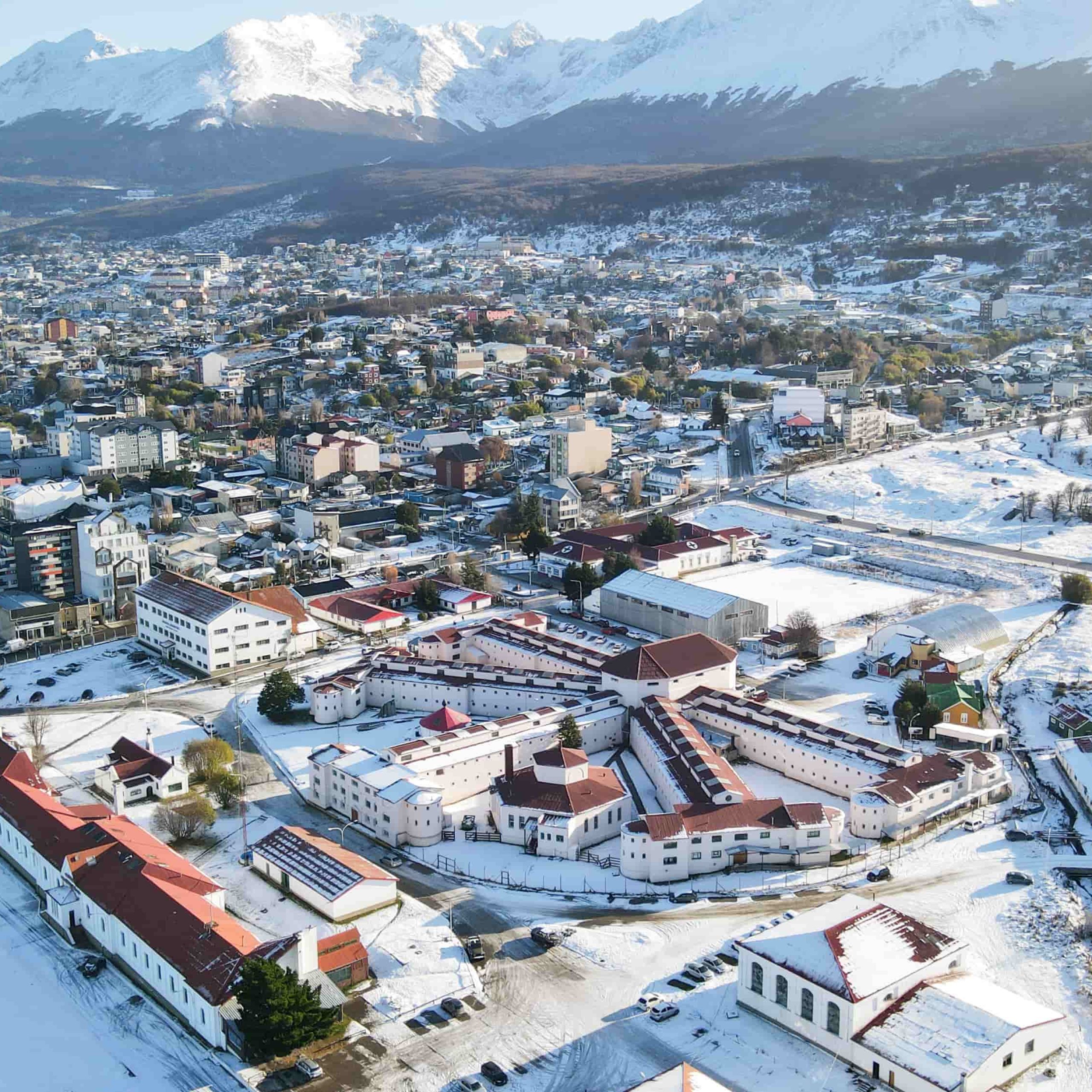
Ushuaia Prison: A State Project Built by Its Own Victims
Ushuaia Prison—also known as the Prison at the End of the World—began operating in 1902. However, the idea of populating Tierra del Fuego with prison labor had been taking shape since the late 19th century. The logic was brutally simple: if no one wanted to live in such a cold and remote place, then those who had no choice would.
Prisoners were transported by ship from Buenos Aires, shackled at the ankles and guarded by military personnel. Many arrived without fully understanding where they were being sent. What they found was a fan-shaped prison with five wings converging into a central courtyard, allowing guards to monitor every movement. The cells were small and freezing, separating each man from the outside world with one unmistakable sound: the clank of the lock.
“I can still hear the sound of the lock when they closed the cell door. That night I couldn’t sleep. I just walked back and forth, crying as I thought of my mother,” one former prisoner recalled years later.
Ushuaia Prison quickly earned the nickname “Argentina’s Siberia.” It was no exaggeration.
Ricardo Rojas: The Writer Who Found Light in the Darkness at the End of the World
Not everyone who ended up in Ushuaia was a criminal.
During Argentina’s so-called Infamous Decade—the 1930s, marked by electoral fraud and political repression—the government exiled intellectuals and Radical Party leaders to the far south. They were not officially prisoners, but they were confined to Ushuaia, forbidden from returning home.
Among them was Ricardo Rojas: writer, former dean of the Faculty of Philosophy and Letters, and former president of the University of Buenos Aires. A man devoted to books, sent to one of the harshest places on the continent.
But Rojas refused to surrender. While the southern winds battered the windows, he wrote. The result was Archipiélago, a remarkable essay challenging Charles Darwin’s evolutionary views on the indigenous peoples of Tierra del Fuego. Where Darwin had seen “savages,” Rojas recognized the Yaghan and Selk’nam peoples as guardians of an ancient culture of immeasurable value—a culture that Western “civilization” was destroying in the name of progress.
Exile did not break Rojas.
It made him even more insightful.
Simón Radowitzky: The Anarchist Who Almost Escaped the End of the World
Few stories from Ushuaia Prison are as dramatic as that of Simón Radowitzky.
A young Ukrainian immigrant with unwavering anarchist ideals, Radowitzky carried convictions that consumed him. On November 14, 1909, Police Chief Ramón Lorenzo Falcón was returning from a funeral at Recoleta Cemetery when Radowitzky threw a homemade bomb from the sidewalk. The explosion killed both Falcón and his secretary.
He was arrested immediately.
During the trial, one detail changed his fate forever. Someone produced his birth certificate, proving he had been only 18 years old at the time of the attack. Because he was legally a minor, the death penalty was commuted to life imprisonment.
But the sentence included an especially cruel punishment.
Every year, on the anniversary of the bombing, he had to spend twenty days in solitary confinement, in complete darkness, surviving only on bread and water.
He was sent to Ushuaia Prison.
The prison already housed notorious inmates, but none carried such an annual sentence.
Then, in 1918, Radowitzky attempted what seemed impossible.
Using scraps of old fabric, he secretly sewed himself a prison guard’s uniform. With help from an underground anarchist network, he slipped out of the prison disguised as a guard and escaped by motorboat across the Beagle Channel.
His freedom lasted only four or five days.
Chilean police captured him in Punta Arenas and returned him to Argentina without even going through formal extradition procedures. Authorities feared his presence might inspire Chilean workers to revolt.
Years later, in 1924, another anarchist, Miguel Arcángel Roscigna, went even further. He infiltrated the prison as an actual guard, planning a second escape for Radowitzky.
Everything had been carefully arranged.
But someone revealed the plot in Congress. Police launched an investigation, Roscigna was expelled, and the escape plan collapsed.
Radowitzky spent 21 years imprisoned in Ushuaia before finally receiving a presidential pardon from Hipólito Yrigoyen in 1930.
El Petiso Orejudo: The Darkest Shadow of the Prison at the End of the World
If one name embodies all the horror that the Prison at the End of the World could contain, it is Cayetano Santos Godino, forever remembered by the press and public imagination as El Petiso Orejudo (“The Big-Eared Midget”).
The son of Italian immigrants, Godino began murdering children while he was still almost a child himself. He was convicted of killing four children and accused of seven additional attempted murders, as well as a series of deliberate arsons. He was only sixteen years old when he was arrested.
He confessed without remorse.
He had no known motive.
He simply enjoyed it.
Doctors of the time declared him mentally insane, diagnosing him with what they described as “incurable imbecility with conscious impulses.” He was first sent to the Las Mercedes Psychiatric Hospital, where he continued attacking fellow patients.
In 1923, authorities made their final decision:
Ushuaia Prison.
He spent nearly thirty years there.
He was subjected to systematic abuse and torture. In 1927, in an act that blended pseudoscience with outright cruelty, prison doctors amputated his ears, believing that his evil nature somehow stemmed from their unusual size.
Godino died in prison in 1944.
The exact circumstances remain unclear.
The official version claims he was beaten to death by fellow inmates.
Others believe prison guards were responsible.
He died three years before the prison permanently closed, taking many of its secrets with him.
Mateo Banks: The Mystic of Azul That Nobody Wanted to Remember
Mateo Banks was a rancher from an Irish immigrant family, raised near the town of Azul in Buenos Aires Province, among vast cattle ranches and the endless silence of the Pampas.
No one would have imagined he would end up in Ushuaia Prison.
But in 1922, Banks murdered eight people: three of his brothers, his sister-in-law, two nieces, and two farm workers.
His motive was simple.
He wanted complete control of the family’s estates.
The murders were cold, calculated, and ruthless.
Inside the prison, guards and inmates nicknamed him “The Mystic.”
He would spend hours sitting silently, staring into the distance as though his mind existed somewhere else entirely.
He always insisted he was innocent.
Almost no one believed him.
Yet no one could completely disprove him either.
His story was eventually overshadowed by more infamous prisoners, but his cell still stands inside the museum today—silent, cold, and as enigmatic as the man who once occupied it.
The Legend of Gardel: Did Argentina’s Greatest Tango Singer Perform Behind Bars at the End of the World?
And now we arrive at the one story that no one has ever been able to fully prove…
…yet no one dares dismiss entirely.
Was Carlos Gardel ever imprisoned in Ushuaia?
According to legend, the answer is yes.
The story claims that between 1905 and 1907, when he was just fourteen or fifteen years old and still known as Carlos Gardés, the future “King of Tango” served time at the Prison at the End of the World.
The alleged reasons vary depending on who tells the story.
Some say it involved a scandal mixing politics and women.
Others claim he acted as a lookout during a shooting.
Another version suggests he was sentenced under Argentina’s Repeat Offenders Law.
The legend gained new life in 1969, when the history magazine Todo es Historia published the testimony of Eduardo Villanueva, a former political prisoner.
Villanueva claimed that while returning to Buenos Aires aboard the steamship SS Chaco, he shared the journey with a cheerful young singer who entertained fellow passengers with his guitar and songs.
Later, Villanueva produced a photograph bearing several signatures—including one that appeared to belong to Gardel himself.
The Ushuaia Prison Museum even dedicates a prison cell to the story.
Inside visitors will find a smiling portrait of Gardel, an illustration on the wall, and a display presenting the legend without either confirming or denying it.
Because the truth is…
There is no official prison record.
The Ushuaia prison archives from that period have disappeared.
Researchers specializing in Gardel point out that at the time he still signed his name Gardés, not Gardel, and that the handwriting on the famous photograph does not match his known signature.
The absence of documents, however, proves nothing.
The prison files from that era were lost long ago.
So…
Myth or reality?
Perhaps the most honest answer is simply to hold on to the image itself:
A young man with an extraordinary voice, imprisoned at the end of the world, singing tangos while the wind howled outside and prison locks echoed through the corridors.
Whether it truly happened or not…
the prison refuses to say.
But it never denies it either.
As historian Carlos Pedro Vairo wrote in his book about the prison:
“If you search the archives for prison records or court sentences, you will find nothing. Yet many remain convinced that the story is true.”
And in Ushuaia—as in tango itself—
sometimes the legend matters more than the documents.
The Final Curtain: Perón Closed the Prison in 1947
The Prison at the End of the World officially closed its doors on March 21, 1947, by decree of President Juan Domingo Perón (Decree No. 7757).
The buildings were transferred to the Argentine Navy, which used them as warehouses and military facilities.
In 1994, the complex was transformed into what is now the Maritime Museum and Ushuaia Prison Museum.
Three years later, in 1997, Argentina’s National Congress declared it a National Historic Monument.
Today, visitors walk the same corridors where thousands of prisoners once lived.
They peer into the tiny cells…
read letters prisoners wrote to their families…
and even see the original iron shackles prisoners wore while working in the surrounding forests.
The historic cell block remains almost exactly as it was decades ago—
frozen in time…
as if the men who lived there had only just walked away.
Because, in a way…
they never truly left.
Would You Like to Visit Ushuaia Prison Yourself?
If this story captivated you, imagine experiencing it in person.
Visiting the Ushuaia Prison Museum is one of the city’s most powerful cultural experiences, and it pairs perfectly with many of the region’s other attractions.
At Ushuaia Travel, we organize tours and excursions to help you experience the End of the World to its fullest.
From sailing the Beagle Channel to exploring Tierra del Fuego National Park, discovering local cuisine, and enjoying landscapes unlike anywhere else on Earth.
👉 Explore our Ushuaia tours and itineraries
If you’d like to discover even more stories, landscapes, and hidden secrets from the End of the World, be sure to visit our blog.
👉 Blog: News from the End of the World
You may also enjoy:
- The 10 Most Instagrammable Spots in Ushuaia
- City & Wine Ushuaia: A Different Way to Discover the City
- Diving in the Beagle Channel: Exploring the Underwater World at the End of the World
Visitor Information
Address: Yaganes 119, Ushuaia, Tierra del Fuego, Argentina
Opening Hours: Every day of the year, 10:00 a.m. – 8:00 p.m.
Phone: +54 (2901) 43-7481
Designation: National Historic Monument (1997)


Comment (0)