

To plan what to do in Ushuaia in 2 days, we need to carefully consider every detail, as it can seem like a challenge. This city—known as “the southernmost city in the world”—offers a wide range of activities, from easy hikes to a helicopter city tour. Despite having a population of around 80,000, Ushuaia boasts unique natural wonders. You’ll find unforgettable landscapes in both winter and summer, with endless daylight hours or long nights depending on the season. The ideal would be to enjoy everything it has to offer on a long trip, but sometimes circumstances call for just 2 days in Ushuaia—so make them count.
During our short but intense visit to Ushuaia, we’ll be able to enjoy iconic and magical places that can’t be found anywhere else. Combining history and nature is no small thing. On the first day, a visit to Tierra del Fuego National Park is undoubtedly a must—it’s an essential stop. With its impressive 70,000 hectares of diverse ecosystems, we’ll see native flora and fauna. Optionally, if we move at a moderate-to-fast pace, we can also take a Beagle Channel navigation.
For the second day, there are several great options: we can take one of the spectacular hikes like Laguna Esmeralda (a walk of approximately 4.5 km), or, if we prefer something less demanding, enjoy a 4×4 excursion to the lakes. Although the weather can be unpredictable, with summer temperatures ranging from 11°C to 13°C, the experience of discovering this corner of the planet is simply unforgettable.
Day 1: Nature and Navigation at the End of the World
Our first day begins with a classic tour—an essential stop that makes this city both historic and iconic. We’ll dedicate a large part of the day to exploring the only National Park in Argentina that combines mountains, coastline, and forest. Later, we’ll set sail on a navigation through the legendary waters of the Beagle Channel. An intense yet truly unforgettable day that will allow us to connect with Patagonian nature at its finest.
Exploring Tierra del Fuego National Park
Tierra del Fuego National Park is, without a doubt, a must-visit for anyone wondering what to do in Ushuaia. Located just 12 kilometers west of the city, this incredible natural landscape protects nearly 70,000 hectares of diverse ecosystems.
The excursion to the park begins early, usually from 8:00 a.m. to 1:30 p.m., when vehicles pick us up from the hotel to kick off the adventure first thing in the morning. The daily departures of the End of the World Train are generally at 9:30 a.m., 12:00 p.m., and 3:00 p.m., with a round-trip duration of approximately 1 hour and 50 minutes.
During the tour, we’ll have the chance to witness a truly unique natural spectacle where diverse landscapes come together. This Argentine National Park brings together coastal areas, forests, and mountains in a single setting. The visit includes stops at several strategic points, while guides explain the main features of each corner of the park.
The highlight of the visit is, without a doubt, the arrival at Lapataia Bay, considered the end of National Route 3. Here, we’ll be able to take the must-have photo every traveler dreams of: standing literally at the last continental point of Argentina. It’s an indescribable feeling to find yourself at the very edge of the world!
Along the way, we’ll get to enjoy several key attractions.
- The Acigami Lake (also known as Lake Roca)
- The Alakush Visitor Center, where we can get detailed information
- The magnificent coastal landscapes of the Beagle Channel
To fully enjoy the park, it’s important to consider the entrance fees. While rates are updated periodically, according to the latest data, the general admission is ARS 30,000, (as of Mayo 2025) while Argentine residents pay ARS 9,000, and provincial residents benefit from a reduced, discounted rate.
The park is open year-round, from 8:00 a.m. to 8:00 p.m., including weekends and public holidays, offering a variety of activities depending on your interests and physical fitness level:
- Hiking on trails such as the Coastal Path (Senda Costera) and Guanaco Hill (Cerro Guanaco)
- Kayaking and canoeing on the Lapataia River
- Native birdwatching
During the visit, we’ll have the chance to deeply connect with nature as our guides share insights about the area’s rich biodiversity, including iconic species such as the beaver, the Andean condor, and a wide variety of birds.
Riding the End of the World Train
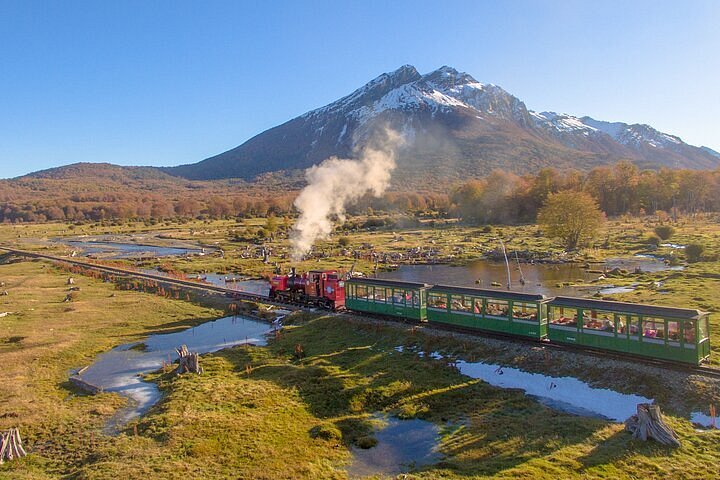
A very special way to complement our visit to the National Park is by taking a ride on the famous End of the World Train, also known as the Southern Fuegian Railway (FCAF). It’s the southernmost railway on the planet—an experience rich in history and offering stunning panoramic views.
The starting point is the End of the World Station, located about 8 kilometers west of Ushuaia. What makes this journey so fascinating is that it follows the same route once used by prisoners from the Ushuaia penal colony as they searched for materials to build the prison.
The history of this train dates back to 1909, when the original railway began operating to transport prisoners. After being inactive for over forty years, the End of the World Train resumed operations in 1994 as a tourist attraction, allowing us today to relive a part of that fascinating past.
The current route covers approximately 7 kilometers—the final stretch of the original 25-kilometer journey. During the ride, which lasts about an hour and ends at the final station located within the park near the entrance to Tierra del Fuego National Park, we’ll pass through landscapes of extraordinary beauty.
Among the most remarkable landscapes we’ll admire along the way are:
- The winding **Pipo River**, which snakes its way through the landscape
- La Macarena waterfall, where the train makes a stop so we can get off and hike up to a viewpoint with spectacular views
- The picturesque “Tree Cemetery”, a poignant reminder of the forced labor carried out by the prisoners
- Magnificent Lenga forests with their rich variety of seasonal colors
What makes this journey so appealing is that it allows us to access areas of Tierra del Fuego National Park that would otherwise be unreachable. Additionally, the train cars feature large panoramic windows so you don’t miss a single detail of the landscape, along with an individual audio guide system available in seven different languages, offering insights into the history and natural surroundings of the region.
The train operates year-round with daily departures at 9:30 a.m., 12:00 p.m., and 3:00 p.m., and the full round-trip journey lasts approximately 1 hour and 50 minutes. There are different service classes available—Tourist Class and Premium Class—to suit each traveler’s preferences and budget.
For those who have booked a guided tour to the National Park, guides and transportation will be waiting at the National Park Station to continue the visit. Travelers exploring independently can return on the same train to the Main Station.
The End of the World Station is worth a visit in itself, as it’s an iconic site where you can see the maintenance workshops, view old photographs from the prison era, shop for souvenirs at the gift store, or enjoy a drink at the café while waiting for the train to depart.
Sailing through the Beagle Channel
To wrap up our action-packed first day exploring what to do in Ushuaia, we can opt for a Beagle Channel navigation in the afternoon. This excursion offers a unique opportunity to discover the magic of this maritime strait located between Argentina and Chile, where the Atlantic and Pacific Oceans meet.
The Beagle Channel owes its name to the HMS Beagle, the British ship that carried out a hydrographic expedition through the region between 1826 and 1830 under the command of Captain Phillip Parker King. Today, it’s one of the most spectacular excursions we can take during our stay at the End of the World, thanks to its majestic beauty and unparalleled landscapes.
The navigation begins at the local tourist port, from where we set out into the waters of the channel to discover its main highlights. All tours include a visit to the famous Les Eclaireurs Lighthouse, often referred to as the “Lighthouse at the End of the World,” although that name is technically incorrect. This iconic lighthouse, located on a small islet, is one of the most photogenic symbols of Tierra del Fuego.
During the tour, we’ll have the opportunity to visit:
- Bird Island, where we can observe birds such as skuas, black-browed albatrosses, steamer ducks, upland geese, kelp gulls, gray gulls, and cormorants
- Sea Lion Island, home to colonies of both South American sea lions (one-hair and two-hair species)
- Some tours include a landing on Bridges Island or Karelo Island, where you can take a short 20-minute hike to learn about the history of the region’s ancient native peoples.
Typical sailings last approximately 2.5 hours, with departures available in the morning (from 10:00 a.m. to 12:30 p.m.) and in the afternoon (from 3:00 p.m. to 5:30 p.m.), allowing us to fit the excursion into our itinerary according to the day’s schedule.
There are different navigation options available at various price points. The basic Beagle Channel tour, which includes a visit to the Lighthouse at the End of the World and the sea lion colonies, costs approximately ARS 85,000 (as of May 2025). For those seeking a more complete experience, there’s also the option to visit a penguin colony for about ARS 140,000 (2024–2025 season), although this tour typically takes longer and is only available during the summer months.
It’s important to note that these prices do not include the port tax, which must be paid directly at the port office before boarding—although in some cases, it may be included in the ticket. It’s recommended to confirm this in advance.
As for the meeting point, the port is located in the city center, within walking distance of most hotels, so transfers are usually not included if your accommodation is downtown.
To fully enjoy the navigation, it’s recommended to wear warm and waterproof clothing, regardless of the time of year, as well as sunscreen and sunglasses to protect yourself from the sun’s reflection on the water. The boats are equipped with an onboard bar service, but you’re also welcome to bring your own mate if you wish.
A key practical detail is that the boats are equipped with accessibility features for travelers with reduced mobility and for families with babies in strollers, making this activity inclusive and suitable for all types of travelers.
At the end of the navigation, as we return to the port, we’ll enjoy a panoramic view of the city of Ushuaia, framed by the surrounding mountains and nature—a breathtaking image that will surely remain etched in our memory.
This Beagle Channel navigation is the perfect complement to our exploration of Tierra del Fuego National Park, allowing us to appreciate Ushuaia’s natural surroundings both by land and by sea. Without a doubt, by the end of this action-packed first day, we’ll feel as though we’ve truly experienced the essence of the End of the World, with its unique landscapes that blend mountains, forests, and sea.
For the second day of our stay, we can choose from different options depending on our preferences: either embark on one of the incredible available hikes or enjoy a 4×4 excursion to the lakes—activities that we’ll explore in detail in the next section.
Day 2: Choose Your Own Adventure – Trekking or 4×4 Exploration
The second day of our journey exploring what to do in Ushuaia in 2 days invites us to choose our own adventure, tailored to our preferences and physical condition. After taking in the coastal and forest landscapes on the first day, we now have the chance to dive into more personalized experiences: from challenging hikes to thrilling 4×4 expeditions. Each option offers a unique perspective of this southern land, allowing us to connect with the natural beauty of Tierra del Fuego in different, yet equally unforgettable, ways.
Trekking to Laguna Esmeralda: Nature in Its Purest Form
One of the most iconic and accessible hikes for those wondering what to do in Ushuaia is the trek to Laguna Esmeralda. Located just 18 kilometers from the city along National Route Nº3 this trail is considered a must-do if your time is limited but you still want to experience a spot that truly represents the essence of Ushuaia.
The trailhead is located on the left side of the road (heading south to north), just a few meters before reaching the winter center “Valle de Lobos.” What makes this trek so special is its perfect blend of accessibility and natural beauty. With a difficulty level rated as moderate/easy, it’s an ideal option for those who want to immerse themselves in nature without taking on an overly demanding hike.
The total route covers approximately 9 kilometers round trip and can be completed in 4 to 5 hours, depending on your pace. total elevation gain is 360 meters, making it a moderately demanding activity but one that is perfectly manageable for most visitors.
The trail is fully marked, which minimizes the chances of getting lost. However, while it’s possible to do it independently, many experts recommend hiring specialized guides for added safety and to enrich the experience with insights about the surrounding environment.
Along the way, we’ll pass through different ecosystems that reveal the landscape diversity of Tierra del Fuego:
- First, we’ll walk through Lenga forests, known for their distinctive foliage that changes color with the seasons.
- Next, we’ll cross vast peat bogs, those unique glacial wetlands that are characteristic of the region.
- Finally, we’ll ascend until we reach the glacial meltwater lagoon, whose striking emerald-colored waters give the site its name.
An interesting aspect of this trail is the chance to observe beaver dams. Although some of the dams along the path have been cleared (no beavers remain), we can still see these habitats up close and gain a better understanding of the ecological impact these introduced rodents have on the local ecosystem.
It’s important to note that the terrain can become muddy and slippery, especially after rain. Therefore, proper waterproof footwear is essential. If doing the hike in winter, crampons become almost mandatory due to the icy patches that can form along the trail.
The organized tours generally include round-trip transfers from your accommodation, a professional guide, trekking poles, and a box lunch. Most departures begin around 9:00 a.m., with an estimated return at 3:00 p.m.
Trek to Laguna de los Témpanos and Vinciguerra Glacier
For more adventurous travelers wondering what to do in Ushuaia in 2 days, the trek to Vinciguerra Glacier and Laguna de los Témpanos is a fascinating option. This moderate-to-high difficulty hike takes us to one of the largest glaciers in Tierra del Fuego, offering a unique experience where the sense of solitude and closeness to nature becomes the true highlight.
The adventure begins early in the morning, when transportation picks us up from our accommodation and takes us to Andorra Valley, specifically to the “Tranquera Verde”, the final access point to this area. From there, we begin the trek along a peat-covered trail, initially walking on flat terrain for about 20 minutes until we reach Arroyo Grande, which we’ll cross via a pedestrian bridge.
During this initial stage of our journey exploring what to do in Ushuaia in 2 days, we’ll have the opportunity to observe beaver dams, reddish peat bogs, and forests made up of native species such as lenga, ñire, and coihue trees. Then begins the first uphill section, which lasts about 2 hours and leads to a spectacular waterfall located at the edge of the vegetation line. This spot is perfect for a rest stop—an ideal place to recharge and capture the stunning scenery around us.
We continue our ascent, crossing valleys and peat bogs, until we finally reach the breathtaking Vinciguerra Glacier and Laguna de los Témpanos, nestled in the heart of the Andes Mountains. Here, surrounded by a stunning landscape, we can enjoy our packed lunch while taking in the beauty of this magnificent body of water, which reflects the surrounding peaks like a natural mirror.
Some important technical details about this excursion:
- Total duration: approximately 8 hours
- Distance covered: 16 kilometers
- Difficulty: Moderate
- Elevation gain: 726 meters
Guided tours include round-trip transportation from your accommodation, a mountain lunch (with vegetarian, vegan, and gluten-free options), and safety equipment such as trekking poles and crampons.
This trail can be particularly challenging in late autumn, winter, or early spring due to the presence of ice, snow, and mud. Therefore, in addition to waterproof footwear, it is recommended to wear appropriate warm clothing year-round.
Susana Peak Trek: The Challenging Alternative
A lesser-known but equally impressive option for those looking for what to do in Ushuaia in 2 days is the the trek to Mount Susana Peak . This trail runs along the southeastern slope of Mount Susana, one of the city’s most distinctive geographic features, noted for both its natural beauty and its local historical significance.
What makes this hike truly extraordinary is that it offers access to exceptional panoramic views of the Fuegian landscape—from the shores of the Beagle Channel to the peaks of the Andes Mountains. It’s likely the only trek in which, in just two hours, you can reach the summit of a mountain and enjoy 360-degree views that encompass the Beagle Channel, the city of Ushuaia, and Tierra del Fuego National Park.
There are two main ways to approach this mountain: a longer route with less elevation gain, and a shorter one with moderate incline, the latter being the most commonly recommended option. The shorter trail begins near Hotel Los Cauquenes, following a road that climbs steadily upward. After walking approximately one kilometer along this dirt road, you’ll find the trailhead on the right, which soon leads you into the wooded area.
From that point on, we enter the native Fuegian forest, characterized by a unique diversity of species such as lenga, canelo, and notro trees, along with other examples of Patagonian flora. After about one hour of walking through these woods, we reach a natural viewpoint that offers the first panoramic glimpses of the surrounding landscape.
The trail continues to the summit of Mount Susana, which rises to 610 meters above sea level. In this section, we leave the forest behind and enter a typical mountain environment, with rocky terrain surrounded by low shrubs and high-Andean vegetation.
Once we reach the summit, the reward is truly unmatched: we can gaze out over the vastness of the Beagle Channel washing along the city’s coastline, and the Andes Mountains framing the extraordinary Fuegian landscape. From this privileged vantage point, we can admire some of the region’s most iconic geographical features, including Tierra del Fuego National Park, Guanaco Hill, Navarino Island, Hoste Island, Ushuaia Bay, and the Darwin Mountain Range, among others.
The technical details of this trek may vary slightly depending on the source, but we can generally consider:
- Difficulty: Level 2 – Easy according to some sources, although others classify it as moderate to challenging depending on conditions and experience level.
- Estimated time: 2½ hours to reach the summit
- Total distance: 8 kilometers round trip
When planning what to do in Ushuaia in 2 days, it’s essential to approach this activity with safety in mind. Carrying the right gear is a must: waterproof hiking boots, thermal base layers, trekking pants, a windproof jacket, gloves, sunscreen, a refillable water bottle, a small backpack, a warm hat, and spare socks.
The professional guides who accompany these excursions not only ensure our safety, but also enhance the experience by describing the Fuegian flora and fauna, helping us gain a deeper understanding of the surrounding nature, its history, and the reasons behind its awe-inspiring landscapes.
4×4 Excursion to Escondido and Fagnano Lakes: Unforgettable Landscapes
If we prefer a less physically demanding but equally exciting alternative for our second day in Ushuaia, the 4×4 excursion to Escondido and Fagnano Lakes is a perfect choice. This adventure combines adrenaline and breathtaking scenery as we journey through the heart of Tierra del Fuego.
The day begins early, around 9:00 a.m., when the 4×4 vehicles pick us up from our hotel. These tours are typically operated with modern off-road trucks that accommodate a maximum of 6 passengers per vehicle, ensuring both comfort and safety. The drivers, in addition to being skilled behind the wheel, also serve as bilingual guides with extensive knowledge of the roads and local culture.
We leave the city heading northeast along National Route Nº3, making our first stop at the Carbajal Valley Viewpoint. From this elevated spot, we can take in the vastness of the valley, its unique topography, and the glaciers that appear in the distance. We continue along the same route, admiring the impressive scenery that features the Cinco Hermanos Mountains and Mount Olivia.
The journey continues to Tierra Mayor Valley, where we can observe Mounts Bonete, Alvear, and others. We pass through the area known as Rancho Hambre, where Route J begins—leading to Estancia Harberton. As we ascend into the mountains, we reach the famous Garibaldi Pass, the highest point of the route, where we enjoy our first panoramic view of Escondido and Fagnano Lakes.
After exploring Ushuaia’s most iconic landscapes, it’s worth taking a moment to reflect on the practical tips that can turn our visit into a truly unforgettable experience. Proper planning can make a big difference when it comes to making the most of our two days at the End of the World.
Practical Tips to Make the Most of Your 2 Days in Ushuaia
Properly planning our visit is essential to discover what to do in Ushuaia in 2 days without missing any of its wonders. While time may be limited, a well-structured itinerary will allow us to enjoy the main attractions of this beautiful Patagonian city to the fullest.
When to Visit Ushuaia?
If we have limited time and are unsure what to do in Ushuaia in 2 days, it’s important to note that the high season in Ushuaia runs from October to April, coinciding with the southern spring and summer. During these months, temperatures are milder—ranging from 5°C to 15°C—and the days are longer, allowing us to make the most of the daylight hours. December, January, and February offer optimal conditions, with over 17 hours of daylight per day, giving us ample time for outdoor activities.
If you’re looking to avoid the crowds, the shoulder seasons—October to November or March to April—are an excellent alternative. During the southern autumn, the lenga and ñire forests are painted in shades of red and gold, creating landscapes of extraordinary photographic beauty.
On the other hand, winter (June to September) transforms Ushuaia into a paradise for snow sports enthusiasts. Cerro Castor, located just 26 km from the city, offers excellent slopes for skiing and snowboarding, while snowmobile tours and dog sledding excursions round out the wide range of winter activities available.
How to Get Around in Ushuaia
Although Ushuaia is a relatively small city, its main natural attractions require transportation. To make the most of our time, we have several options:
- Organized Tours: They represent the most convenient and efficient option, especially for first-time visitors. They include transportation, a guide, and sometimes entrance fees to the attractions.
- Car Rental: Offers greater independence and flexibility—ideal if you want to set your own schedule. However, during high season, it’s recommended to book in advance.
- Public Transportation: There are no buses that go all the way to the national park. However, they can be a good option for getting around within the city.
Budget: How Much Does It Cost to Visit Ushuaia
Properly planning your budget and making the most of your 2 days in Ushuaia will be essential. As a general reference (subject to change, as of May 2025):
- Accomodation: From ARS 15,000 per night in hostels to ARS 50,000 or more in higher-end hotels.
- Meals: Expect to pay between ARS 5,000–10,000 for simple breakfasts and lunches, and from ARS 8,000 for dinners at restaurants.
- Excursions: A visit to Tierra del Fuego National Park ranges from ARS 10,000 to 30,000, while a Beagle Channel navigation can cost between ARS 85,000 and 140,000, depending on the type of tour selected.
- Transportation: The transfer from the airport to your hotel with authorized tourism agencies ranges between ARS 15,000 and 20,000 per person.
Additional Tips to Make the Most of Your Experience
- Book in Advance: Especially during high season, the most popular excursions tend to fill up quickly.
- Check the Weather Forecast:: The changing weather can affect certain activities, so it’s wise to stay flexible with your itinerary.
- Duty-Free Shopping: Ushuaia is a free-trade zone, offering a great opportunity to purchase electronics and other goods at competitive prices..
- Internet Connection:: While the urban center has good connectivity, signal coverage in natural areas can be limited. It’s recommended to download offline maps and confirm excursion details in advance.
- Documentation: For excursions that approach the Chilean border, always carry your passport or national ID.
With these practical tips, we’re ready to fully enjoy our experience at the End of the World. Whether it’s exploring Tierra del Fuego National Park, sailing through the Beagle Channel, taking on one of the breathtaking hikes, or embarking on a 4×4 adventure to the lakes, Ushuaia will offer us landscapes and moments that will stay with us long after we’ve returned home.

Comment (0)